
My Story as a Researcher
Beyond Blind Trust: My Journey in Privacy-Preserving Cryptography and Data Sovereignty
We’ve all heard the foundational rule of the internet: Don't trust, verify. But as a computer engineer and researcher, I’ve spent the better part of my career asking a much trickier follow-up question: How can you verify data without forcing people to expose their most private information in the process?
My path in tech started at the Technical University of Munich (TUM), where I completed my bachelor’s and master’s degrees in Electrical and Computer Engineering. I stayed in academia to dive deeper into applied cryptography, ultimately earning my doctorate (Dr.-Ing.). My dissertation tackled a challenge that lies at the heart of today's digital economy: policy-driven data sovereignty and provenance. In plain terms, I design practical cryptographic systems that prove exactly where data came from and that it hasn’t been tampered with—all while keeping the underlying contents completely private.
The Core Mission: Redefining Trust on the Web
If you look at how the web handles data today, there is a massive architectural gap.
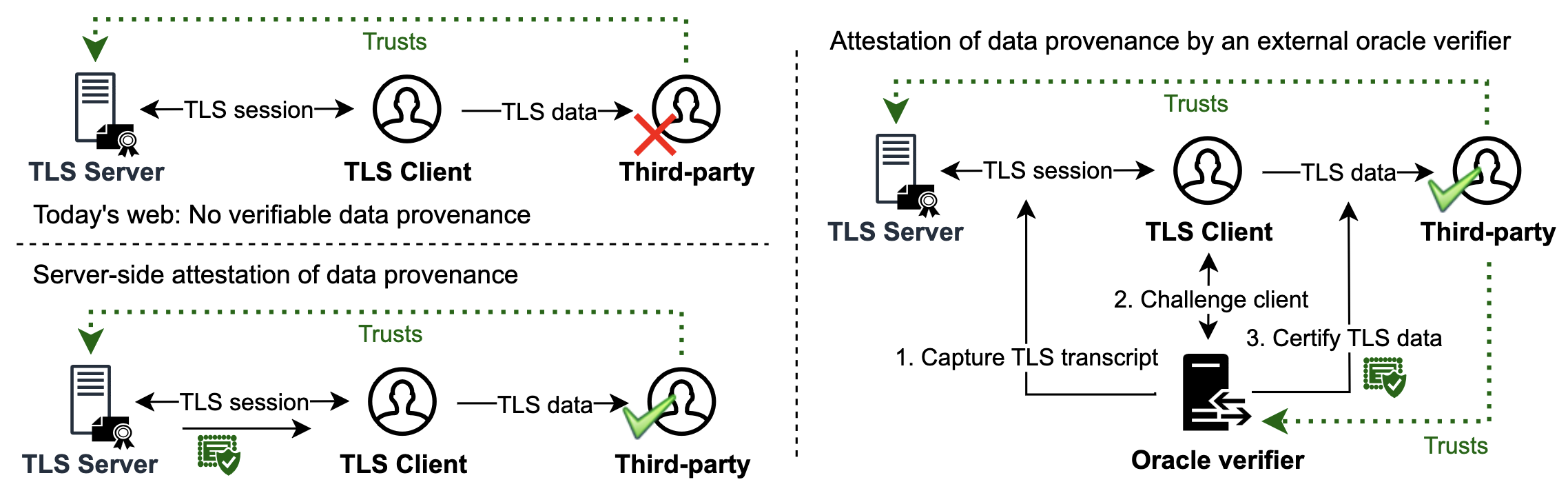
Take a standard TLS (Transport Layer Security) session. It does an incredible job of securing data while it's traveling between a server and your browser. But what happens if you want to prove to a third party that you received a specific, authentic piece of data from that server?
As things stand, you can’t easily prove it without giving up total privacy, handing over raw credentials, or relying on a server that explicitly supports complex signatures.
My research focuses on bridging this gap between theoretical cryptography and real-world deployable systems. I look at how we can use Zero-Knowledge Proofs (ZKPs), verifiable computation, and privacy-enhancing technologies (PETs) to allow data to be shared, verified, and processed seamlessly, ensuring user privacy and data control are preserved by design.
Translating Math into Real-World Code
Instead of just looking at cryptography on a whiteboard, I focus on building systems where trust is established mathematically rather than blindly assumed. Some of my primary research contributions include:
- Verifiable Provenance Over Encrypted Channels: Allowing users to prove the authenticity of data retrieved via standard TLS traffic without revealing sensitive payloads or credentials to third parties.
- ZK-Based Authentication: Creating mechanisms that prove identity or access rights without leaking passwords, tracking tokens, or cryptographic keys.
- Compiling Privacy Policies into Cryptography: Turning high-level, human-readable data privacy regulations into immutable, mathematically enforced cryptographic representations.
Cutting-Edge Research: Zero-Knowledge Wormholes at IEEE ICBC 2026
My latest work continues this push into advanced web and distributed ledger scalability. I’m proud to share that my most recent paper, "Enhanced EIP-7503 Zero-Knowledge Wormholes," is being presented at the upcoming IEEE ICBC 2026 Workshops.
This research focuses on optimizing zero-knowledge proof mechanics to allow secure, private, and highly efficient communication and token state transitions across distributed environments. It represents exactly what drives me as a researcher: turning complex, cutting-edge mathematics into practical, scalable infrastructure that enhances sovereignty on the modern web.
Looking Ahead
As our world relies more heavily on automated verification, AI data ingestion, and cross-border data sharing, keeping a firm grip on our own digital footprints is non-negotiable. I look forward to continuing to build the tools, frameworks, and protocols that make a truly private, verifiable web possible.
Are you working on data provenance, cryptographic PETs, or heading to security conferences this year? Let's connect and discuss the future of data sovereignty!